
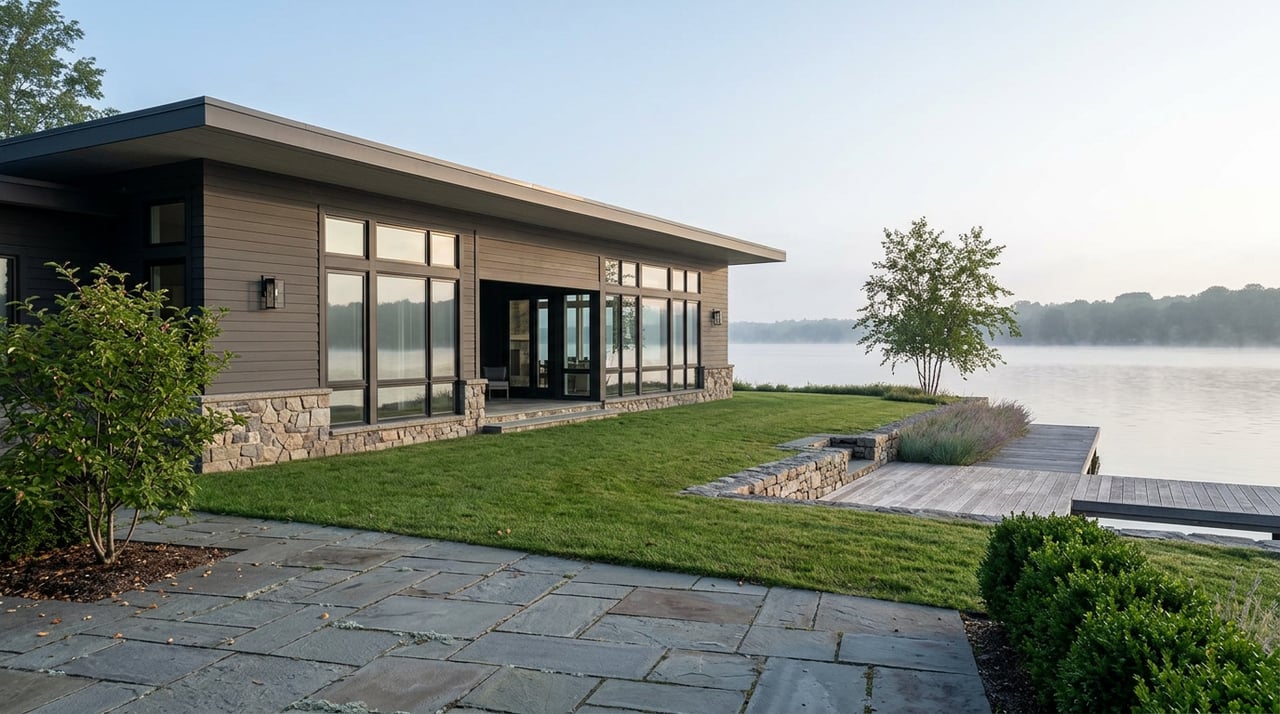
By the time most buyers learn their "lakefront" offer sits on a well and a septic field instead of municipal water and sewer, they've usually already waived the inspection contingency. A few lakes over, a different buyer discovers that replacing a failing seawall requires a state shoreline permit that adds a month to closing before a single contractor picks up a hammer. Neither buyer was misled. The listing price was accurate. It just wasn't telling them which West Bloomfield they were actually buying into.
That gap matters because West Bloomfield gets marketed, understandably, as one place: Oakland County's lake township, roughly thirty-one square miles wrapped around Cass Lake, Pine Lake, Walnut Lake, and a scatter of smaller water. As of June 2026, the typical home value for the township sat near $467,000, and recent closings this summer clustered somewhere in the mid-$400,000s. That single figure is doing the work of describing at least four markets that almost never compete against each other for the same buyer: condos priced in the low $300,000s and under, inland colonials off Maple and Drake in the $400,000s to $600,000s, and lakefront that starts around $600,000 to $800,000 on the smaller lakes and climbs past $3 million on the most desirable shoreline. A buyer comparing that one median to a listing photo of a lake house is comparing a citywide average to a category it barely touches.
The Median Blends Markets That Don't Trade Against Each Other
The mechanism here isn't mysterious once you see it. A condo buyer and a Pine Lake buyer are not shopping the same inventory, aren't competing for the same square footage, and aren't pricing against the same comps. Folding them into one number produces a figure that's true in aggregate and useless at the offer table. This is the same trap that shows up anywhere a municipality contains structurally different housing stock under one label. In West Bloomfield, the split is unusually clean: water access, or the lack of it, is the dividing line, and it's a bigger dividing line than square footage, lot size, or year built.
Where it gets more interesting, and where most buyers stop paying attention too soon, is that "lakefront" isn't one category either.
Not Every Lake Is the Same Asset
Michigan classifies inland lakes by what's allowed on the water, and West Bloomfield's lakes split along that line in ways that show up directly in price per square foot.
| Lake | Motor classification | Access | What actually shapes the price |
|---|---|---|---|
| Cass Lake | All-sports | Public, DNR launch at Dodge Park | Oakland County's largest lake at 1,280 acres; the public launch means real boat traffic from off-lake, which widens the price range across the shoreline |
| Union Lake | All-sports | Public | Home to a mid-lake sandbar and the Matter of Taste restaurant; the social, busy character keeps per-square-foot pricing more accessible than the private lakes despite comparable size |
| Pine Lake | All-sports | Private | Runs along Orchard Lake Road; commands some of the township's highest luxury pricing, and many homes here still run on well and septic rather than municipal service |
| Walnut Lake | All-sports, with enforced quiet hours from 6:30 p.m. to 10 a.m. | Private | Fewer homes, larger estates, and restrictions on speed and towing during quiet hours; consistently among the highest per-square-foot prices in the township |
| Middle Straits Lake | All-sports, with quieter rules on Sundays and holidays | Semi-private, small public ramp with private beaches | Priced below Union and Upper Straits despite similar size, largely because it draws less name recognition |
| Green Lake | Electric-motor only | Private | No gas motors, no wake, a genuinely quiet lake; still commands a real premium because demand for calm water is its own market, not a discount version of an all-sports lake |
Read that table as evidence, not trivia. The premium buyers pay isn't simply "waterfront versus not." It's a combination of two variables working together: how the lake is legally classified for motorized use, and whether access is public or restricted to residents and their guests. Walnut Lake is neither the largest nor the closest to a freeway, but its private access and enforced quiet hours put it at the top of the per-square-foot range. Union Lake is a big, genuinely fun all-sports lake with a real gathering spot at its sandbar, and it still prices more moderately than Walnut or Pine because public access means anyone with a trailer and a launch fee shares the water. Green Lake proves the pattern runs both directions: an electric-only lake isn't a lesser asset, it's a different asset, and buyers who specifically want quiet water pay for it the same way boating buyers pay for horsepower access on Cass or Union.
If you're comparing neighborhoods and someone quotes you a single price per square foot for "West Bloomfield lakefront," ask which lake, ask whether it's all-sports or electric-only, and ask whether access is public or private. Those three answers move the number more than the size of the house does.
The Part That Surfaces After the Offer, Not Before
This is where the friction gets real for anyone planning to renovate or rebuild rather than move in as-is, which describes a meaningful share of West Bloomfield lakefront buyers given how much of the older cottage stock on lakes like Pine and Green has already been torn down for larger custom construction.
Two things tend to surface late in the process, after an offer is accepted and due diligence starts:
Utilities aren't uniform. Some lakefront pockets, including parts of Pine Lake, still run on private well and septic rather than city water and sewer, even as neighboring streets tie into municipal service. That changes the inspection scope, the ongoing maintenance conversation, and in some cases the renovation timeline, since well and septic permits route through Oakland County's Health Division separately from the township's building permit.
Shoreline work triggers state review, not just local review. The Michigan Department of Environment, Great Lakes, and Energy regulates construction within defined setbacks of inland lakes, and that authority sits on top of, not instead of, the West Bloomfield Township Building Division's own plan review. One design-build firm working regularly in the township, Reschka Design Build, puts a real number on what that means in practice: lakefront properties with EGLE coordination can add two to four weeks to preconstruction, and waterfront whole-home remodels commonly run $30,000 to $80,000 higher than comparable inland projects once foundation work, moisture management near the waterline, and the state permitting process are priced in.
Neither of these facts appears on a listing sheet. Both of them change the math on what a lakefront purchase actually costs to own or improve, and both are worth confirming before an offer goes in, not after.
What This Means If You're Actually Comparing
If you're weighing West Bloomfield against another Oakland County community, the township median is a reasonable starting point for orientation and a poor tool for anything more specific. The more useful exercise is to name the lake, confirm its classification and access type, and ask directly whether the parcel runs on municipal utilities or well and septic. Those answers, not the citywide average, are what actually price a specific offer.
Is one lake in West Bloomfield simply "the best" one to buy on? No. Buyers who want boating culture and don't mind public access tend toward Cass or Union. Buyers who want privacy and quiet enforce a preference for Walnut or Green. Both are legitimate, differently priced markets, not a hierarchy.
Does an electric-motor-only lake mean a lower price? Not necessarily. Green Lake's no-wake designation reflects a deliberate choice by residents to keep the water calm, and homes there still command genuine luxury pricing. The classification defines the buyer it attracts, not automatically the ceiling on value.
Buying or selling on any of these lakes rewards someone who already knows which questions to ask before the inspection period starts, not after. That's the kind of groundwork Cindy Kahn and her team walk clients through as a matter of course, whether the conversation starts with a specific lake, a specific street, or just a general sense that it's time to make a move. If you're weighing West Bloomfield against the rest of Oakland County, Request Your KahnCierge Consultation and get a read on the market that starts with the actual parcel, not the township average.